

DevOps Best Practices for Cloud Teams: A Practical Playbook
Cloud DevOps is about building a delivery and operations system that can change safely under constant pressure. Here's a practical playbook for getting there.
DevOps is the practice of unifying software development and IT operations into one continuous workflow for building, testing, and releasing software. Cloud DevOps isn't only about moving faster. It's about building a delivery and operations system that can change safely under constant pressure: new releases, elastic infrastructure, evolving threats, and unpredictable costs. Top performing teams treat DevOps as an operating model with clear ownership, automated controls, and measurable outcomes, adopting these practices incrementally rather than all at once.
Align on Service Ownership and Guardrails
Before adding more automation, make ownership and boundaries explicit, since ambiguity leads to slow incident response, unmanaged spend, and inconsistent controls.
-
Define service ownership: every workload should have a named team responsible for delivery, reliability, security, and cost visibility.
-
Standardize environments: agree on what “dev,” “stage,” and “prod” mean, including access rules and data handling.
-
Set guardrails as policy: approved regions, encryption requirements, tagging standards, identity rules, and budget thresholds should be documented and enforceable through cloud governance.
-
Keep autonomy inside boundaries: teams move quickly when the safe path is also the easy path.
Make ownership operational by establishing an on-call rotation, defining escalation paths, and keeping runbooks close to the service. When something breaks at 2 a.m., what separates resilience from chaos is usually clarity: who owns it, and which actions are safe to take.
Build Continuous Integration That Developers Trust
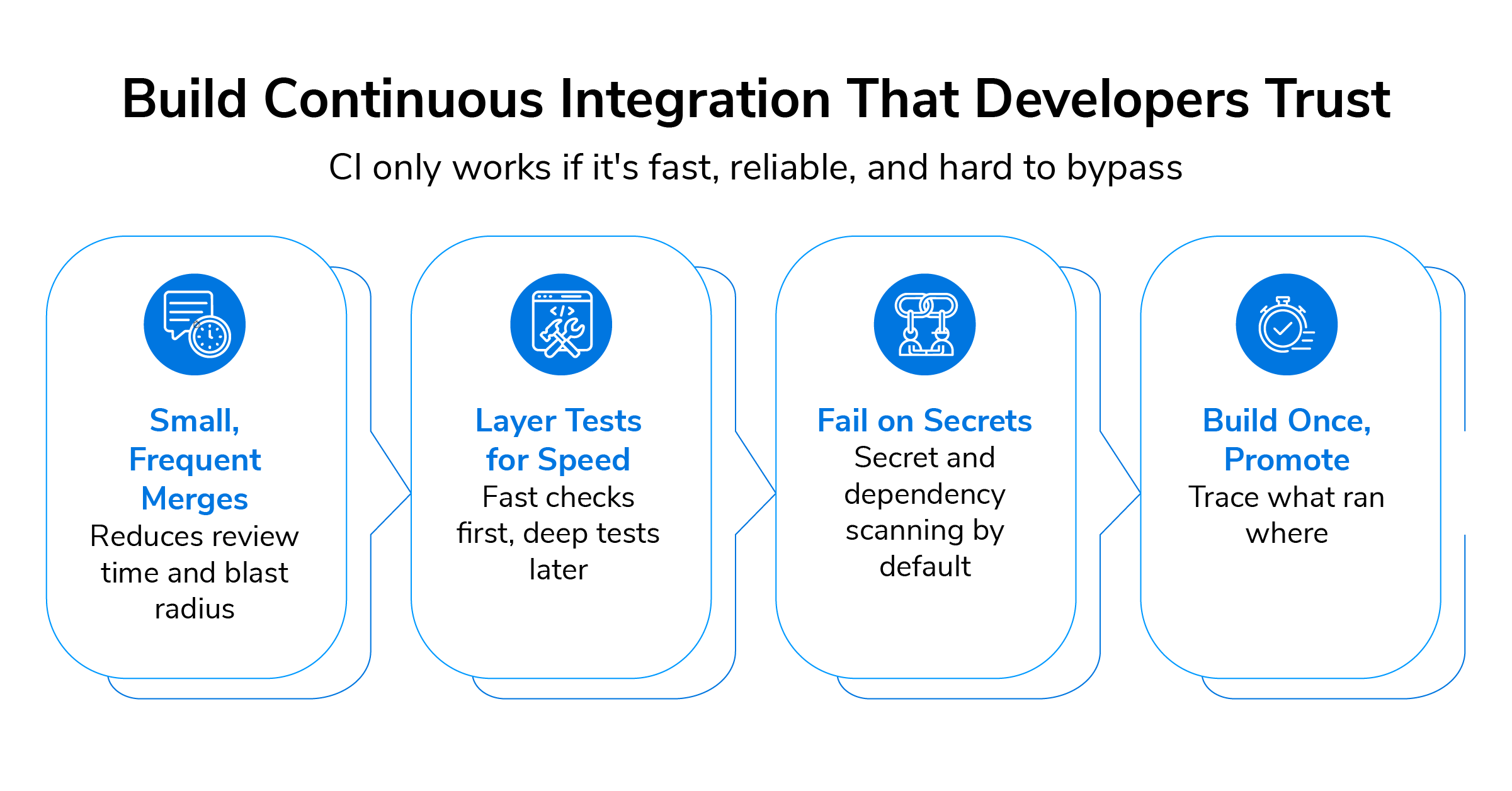
Continuous integration (CI) is the operational core of cloud delivery: early evidence that a change is safe to promote, before defects accumulate. CI only works if it's fast, reliable, and hard to bypass.
-
Prefer small, frequent merges: smaller pull requests reduce review time and blast radius.
-
Layer tests for speed: linting and unit tests first, then integration and contract tests, then targeted end-to-end tests for critical journeys.
-
Fail on secrets and risky dependencies: include secret detection and dependency scanning as default checks.
-
Build once, promote artifacts: move versioned artifacts through environments so you can trace what ran where.
Trunk-based development often pairs well with cloud delivery, since it reduces long-lived branch drift. To keep CI fast at scale, invest in caching dependencies, parallel test runs, and isolating slow integration suites. If developers don't trust CI, they'll route around it, so treat pipeline health as production health.
Standardize CI/CD and Reduce Release Risk
Continuous delivery (CD) turns proven artifacts into predictable releases. The objective is consistent, repeatable change with clear rollback paths.
-
Use deployment templates: standardize pipeline stages and approvals so teams don't reinvent controls for every service.
-
Automate progressive delivery where it helps: canary releases, blue/green deployments, and feature flags all reduce blast radius.
-
Gate by risk, not by habit: higher-impact changes should require stronger evidence, like security results and test coverage.
-
Practice rollback: ensure rollbacks are tested, fast, and documented for schema changes.
For regulated environments, standardization also improves auditability and compliance, an approach reflected in NIST's own Secure Software Development Framework for federal suppliers.1 A good pipeline automatically produces release evidence, artifact version, tests run, policy checks, and approvals, so routine, reversible releases let teams deploy more often without added stress.
Adopt a Platform Engineering Approach
As cloud organizations grow, “every team builds its own pipeline” gets expensive and inconsistent. Platform engineering provides a paved road instead: approved templates, shared CI/CD components, secure defaults, and self-service workflows teams can use without reinventing controls.
-
Offer golden paths: starter repos, pipeline templates, and service scaffolding with security and observability built in.
-
Standardize identities and permissions: make least privilege the default and keep changes traceable.
-
Enable self-service safely: teams provision and deploy without opening tickets, while guardrails enforce what must be true.
The best platform approach is product-minded: measure adoption, reduce friction, and treat developer experience as a speed multiplier.
Use Infrastructure as Code and Immutable Environments
Cloud systems fail quietly when infrastructure is changed manually. Infrastructure as Code (IaC) keeps infrastructure versioned, reviewable, and repeatable, one of the highest-leverage DevOps practices available.
-
Codify provisioning: use tools like Terraform or CloudFormation for networks, compute, storage, and permissions.
-
Review infrastructure like application code: pull requests, peer review, and policy checks apply to IaC changes too.
-
Reduce drift: detect configuration drift and converge back to the declared state instead of ad hoc fixes.
-
Prefer immutable patterns: replace instances or containers rather than patching in place.
IaC also creates a clear record of who changed what and why, giving end-to-end traceability from commit to infrastructure to runtime.
Shift Security Left with Policy-as-Code
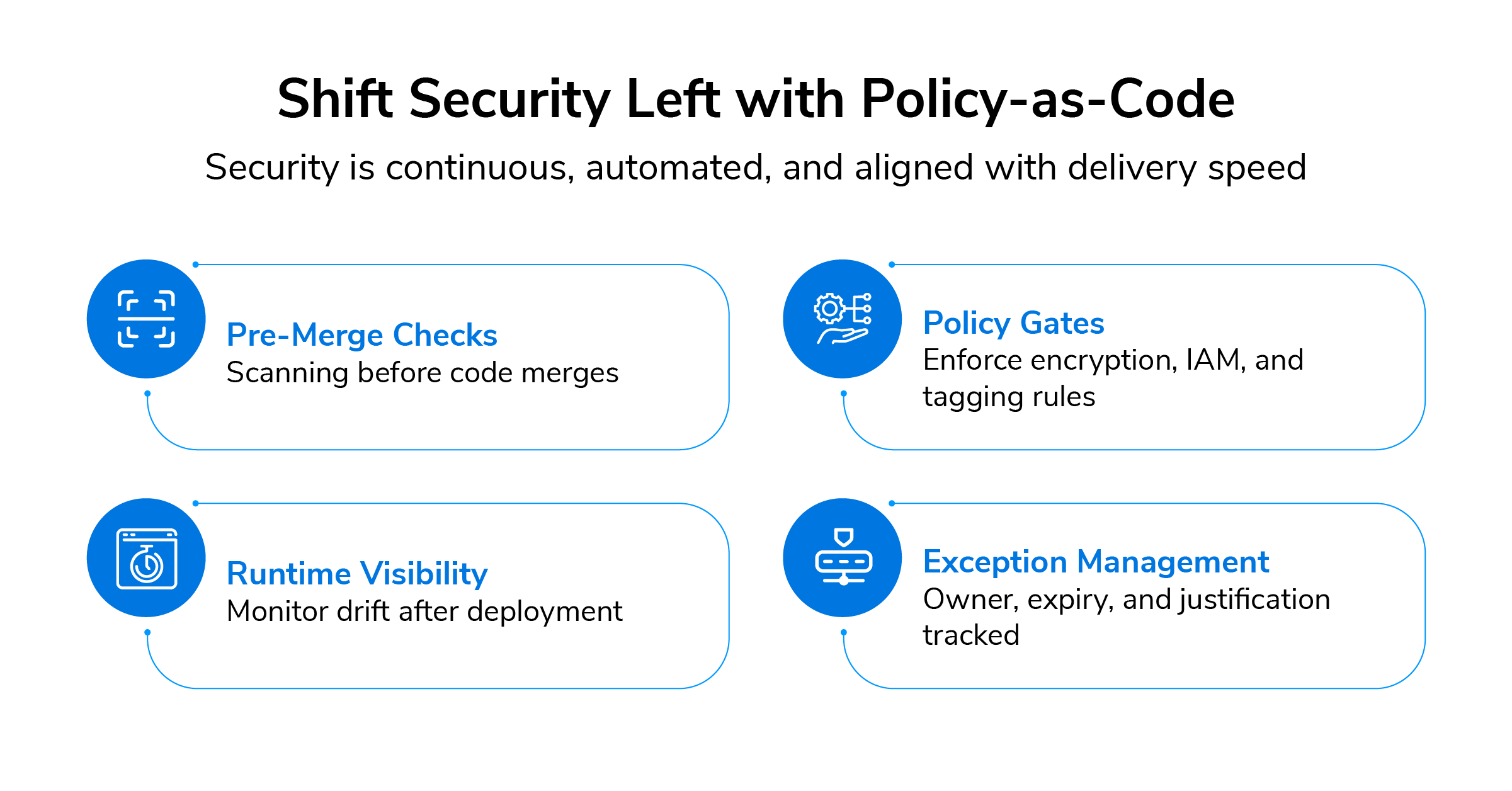
DevSecOps works when security is continuous, automated, and aligned with delivery speed. “Shift left” means earlier checks, but mature teams also keep security posture active after deployment through continuous monitoring and drift control.
-
Pre-merge checks: secret scanning, static analysis, dependency scanning, and container/IaC scanning on pull requests.
-
Policy gates: enforce encryption, approved instance types, least-privilege IAM2, tagging, and network controls.
-
Runtime visibility: monitor identity anomalies, exposed services, and post-deployment configuration drift, an area Graphion is built to handle.
-
Exception management: track exceptions with an owner, expiry date, and justification.
Policy-as-code helps teams move faster: approvals become predictable and verifiable rather than subjective, and controls become testable like any other change.
Make Observability Part of the Definition of Done
In cloud environments, delivery doesn't end at deployment: observability validates releases, shortens troubleshooting, and feeds learning back into the backlog.
-
Instrument consistently: standardize logging, metrics, and traces so teams debug services consistently.
-
Correlate releases to signals: tie deployments to changes in latency, error rates, and business KPIs.
-
Adopt SLOs for critical services: define measurable reliability targets and use error budgets to balance change with stability.
-
Run blameless postmortems: focus on improving tests and guardrails, not personal fault.
A practical rule: if a service can page you, it should also tell you why, with dashboards showing what broke and who's impacted.
Design for Resilience and Recovery
Cloud elasticity doesn't guarantee reliability. Resilience is designed, tested, and operationalized, especially across dependencies like queues, databases, and APIs.
-
Test failure modes: introduce controlled latency, dependency outages, and throttling to validate timeouts, retries, and circuit breakers.
-
Harden data recovery: verify backups, run restore drills, and document RTO/RPO targets.
-
Run game days: practice incident scenarios so teams learn under low stress and refine playbooks.
This pays back in lower change failure rate and faster recovery, especially alongside progressive delivery and strong observability.
Control Cloud Cost with Engineering Signals
Cloud cost is shaped by architecture, scaling rules, data movement, logging volume, and environment sprawl. Treat cost as a first-class engineering signal so teams see economic impact early, not after the invoice.
-
Make spend attributable: enforce tagging and ownership so cost maps to services, teams, and environments.
-
Review cost alongside reliability: include cost anomalies and top drivers in reviews.
-
Set guardrails: budgets, quota controls, and policy rules keep spend and experimentation safe.
-
Optimize non-production: right-size dev/test environments and schedule shutdowns to reduce waste.
Move beyond total spend to unit economics where possible, such as cost per transaction or environment. When teams see how design changes affect unit cost, optimization becomes an engineering practice, not an after-the-fact financial one.
Measure Outcomes with a Small, Durable Scorecard
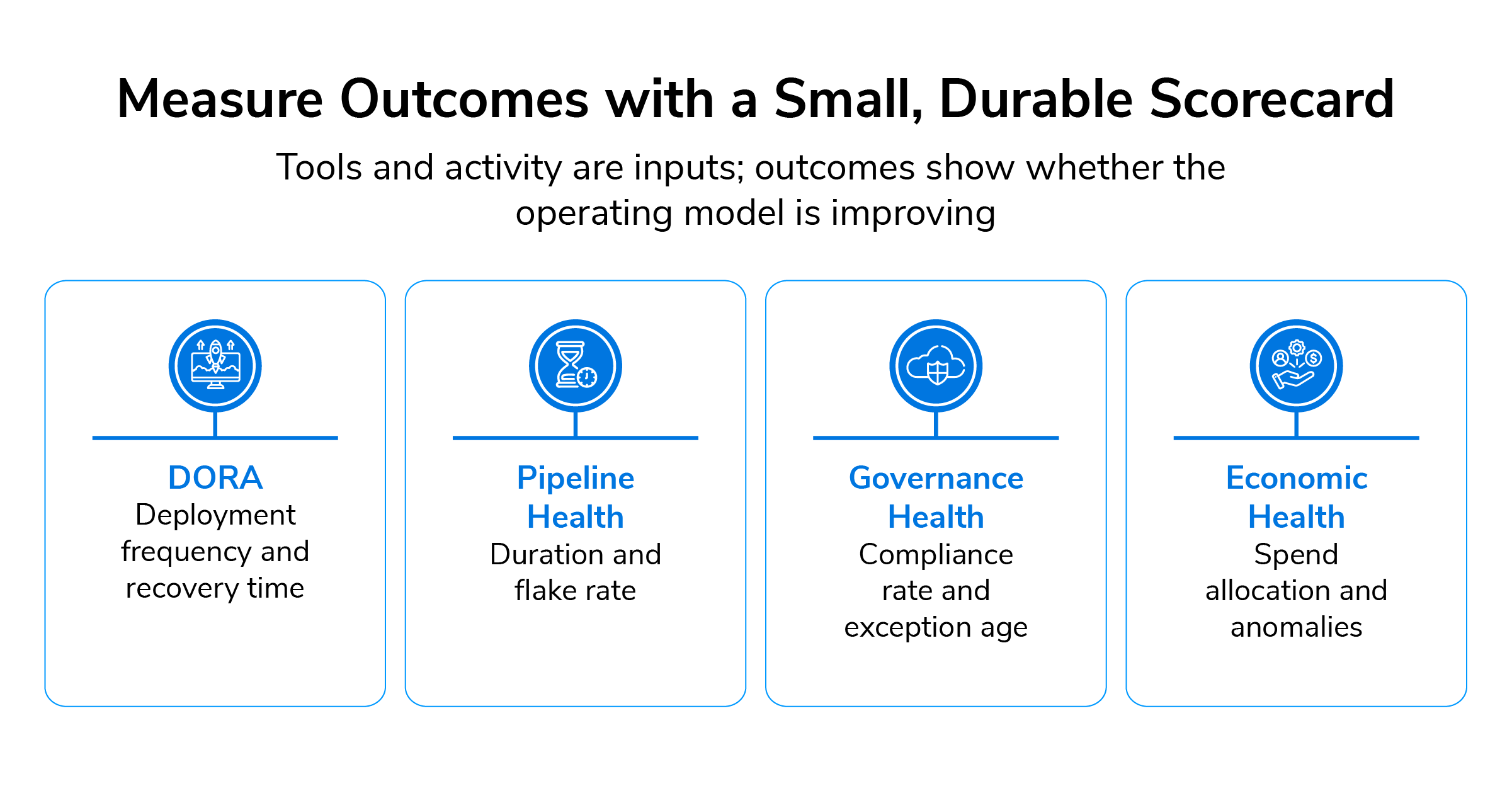
Tools and activity are inputs; outcomes show whether the operating model is improving. Start with the DORA metrics, an industry-standard framework from Google Cloud's DevOps Research and Assessment team,3 plus a small set of cloud-specific measures.
-
DORA: deployment frequency, lead time for changes, change failure rate, and mean time to recovery.
-
Pipeline health: duration, flake rate, and top causes of failure.
-
Governance health: policy compliance rate and exception age.
-
Economic health: percent of spend correctly allocated, plus recurring anomaly categories.
Use metrics to remove friction and fund improvements.
A Practical Takeaway
DevOps best practices work best when they reinforce each other: trusted CI, standardized CD, IaC, policy-as-code security, strong observability, and cost governance tied to ownership.
How CoreStack Supports DevOps Best Practices for Cloud Teams
Every practice in this playbook, from policy-as-code guardrails to cost governance and runtime visibility, is what CoreStack FinOps+ operationalizes. CloudOps, a core FinOps+ module, combines rule-based automation, tagging governance, and anomaly detection into one dashboard, keeping DevOps signals automated and continuous.
Ready to bring this playbook to life? Request a demo to see how FinOps+, including CloudOps, supports your DevOps practice.
Frequently Asked Questions
What are the most important DevOps best practices?
Start with trusted continuous integration, Infrastructure as Code, automated security checks, strong observability, and clear ownership for reliability and cost. These foundations improve speed without increasing risk.
How can teams fix a slow CI pipeline?
Split tests into fast and slow stages, remove or quarantine flaky tests, parallelize where possible, and stabilize dependencies, so CI is reliable and fast enough that developers use it by default.
Which DevOps tools should cloud teams prioritize first?
Prioritize source control and CI/CD, then add IaC, secrets management, and baseline observability, before expanding into policy-as-code and security scanning, so governance is automated.
How does DevOps help control cloud costs effectively?
Make spend attributable with tagging and ownership, detect anomalies early, enforce budget guardrails, and optimize non-production environments, so teams correct waste while still shipping regularly.


