

Data Governance Frameworks: What Enterprises Need to Know
Data governance is evolving rapidly as enterprises operate across distributed public, private, and hybrid clouds. Here's what a modern framework needs to cover.
Data governance is evolving rapidly, with enterprises facing new challenges as operating across a network of distributed public, private, and hybrid clouds becomes the standard.
Agentic AI is transforming how data is managed. Agents now have access to unprecedented amounts of data and continuously operate to improve data accuracy in ways static tools never could.
Compliance standards are evolving fast to address this changing environment. The European Union is taking the most forceful approach to control how data can be accessed and used, with the General Data Protection Regulation (GDPR), governing how organizations must handle personal information.1 The EU AI Act, which went into effect in 2024, outlines how AI systems and models must be handled based on their potential risk, including that high-risk systems require appropriate data governance practices to reduce bias.2 Enterprises need a robust framework and set of controls to navigate these changes and ensure compliance.
Policy-bound agents, which operate within specifically approved guidelines, offer enterprises a scalable, auditable solution to drive continuous observation and action, by automating many routine data governance tasks.
The Evolving Landscape: Why Data Governance Matters
Data is a vital asset for modern enterprises. Managing it effectively is critical to ensuring continued business operations, safe and secure R&D, and personalized customer support and retention. Access to data underlies an organization's ability to securely manage and govern multi-cloud environments across providers and locations.
Effective data governance enhances decision-making and supports operational efficiency by making sure appropriate levels of access exist across every cloud, account, and tenant, even as regulatory landscapes continuously evolve.
Key considerations for a robust data governance framework include:
-
Appropriate access controls and permissioning
-
High-fidelity data that can be trusted, especially if it will be ingested by AI models to create usable outputs
-
Cross-functional alignment across teams, including security, IT, and finance to agree on shared foundations and expectations
Beyond demonstrating compliance, a strong data governance approach helps enterprises maintain customer trust, protects brand reputation, and minimizes exposure risk to harsh legal and financial penalties.
Core Principles of Modern Data Governance Frameworks
Modern data governance frameworks are built on foundational principles that ensure data integrity and usability.
The core principles include:
-
Transparency: Promotes clarity in data use and processing
-
Stewardship: Establishes ownership and oversight
-
Quality: Ensures data is accurate and reliable
-
Security: Protects against breaches and unauthorized access
By embedding these principles into their cloud governance approach, enterprises can further business objectives and compliance as multi-cloud environments evolve.
CSPM plays a complementary role here, securing the infrastructure that data lives on so the access controls and protections this framework calls for actually hold up in practice. Learn more in What Is CSPM?
Data Governance Models: Aligning with Multi-Cloud and Hybrid Strategies
Data governance models must support multi-cloud and hybrid strategies, since enterprises use a complex approach to govern cloud environments.
A unified governance model ensures consistency across cloud platforms, enabling seamless data management. Adaptability is key, as frameworks need to evolve with technological advances without sacrificing control.
Collaboration is also critical, as IT, FinOps, and security teams need to align on applicable governance policies to ensure seamless execution.
Automation can help streamline governance across multiple clouds, with workflows and policy-bound agents executing tasks like routine compliance checks to improve efficiency.
AI Governance Frameworks: Automation, Accuracy, and Accountability
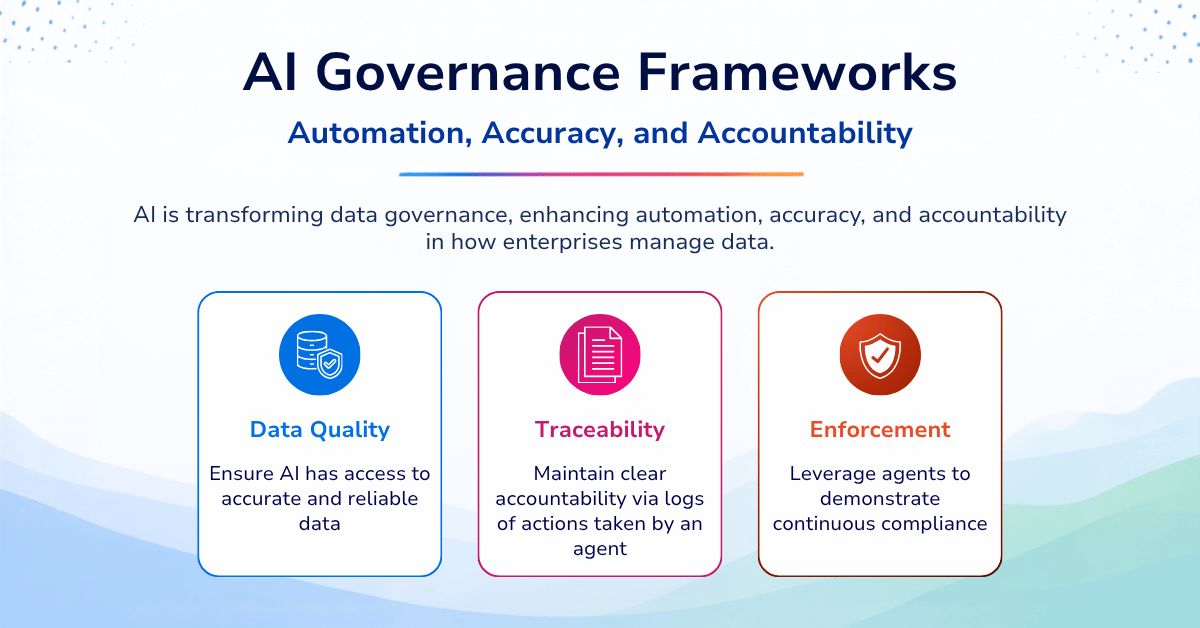
AI is transforming data governance, enhancing automation, accuracy, and accountability in how enterprises manage data.
Automation is pivotal in modern governance frameworks. AI-driven tools, including AI-powered tagging, can streamline repetitive tasks, reduce errors, and free up employees' time for more strategic work.
While automation is powerful, its real value rests in accuracy and time savings by identifying discrepancies quickly, and ensuring reliable data is used for decision-making.
AI frameworks also support real-time decision-making by agents. This is part of a broader industry shift toward leveraging autonomous assessment and governance capabilities that goes beyond simple automation scripts.
Effectively integrating AI into a data governance model involves:
-
Data Quality: Ensure AI has access to accurate and reliable data
-
Traceability: Maintain clear accountability via logs of actions taken by an agent
-
Enforcement: Leverage agents to demonstrate continuous compliance
Data Compliance Standards: Navigating Global and Sector-Specific Regulations
Data compliance is increasingly complex in today's global landscape, with enterprises facing both regional and industry-specific regulations.
Global regulations like GDPR impact organizations across the world who process personal data for people in the EU, making compliance essential to avoid penalties. In the US, the California Consumer Protection Act (CCPA) affects companies handling data of California residents, requiring strict adherence.
Sector-specific regulations add additional complexity. For example, the Health Insurance Portability and Accountability Act (HIPAA) provides patients with privacy rights over how their health data can be disclosed and ensures that appropriate security practices are followed for electronically stored health data.3 Entities in regulated industries that are subject to specific regulations, such as HIPPA, require ongoing compliance to mitigate legal and financial risks.
Critical components of a compliance strategy include:
-
Regulatory Awareness: Stay informed about the latest updates and changes to industry-specific laws and regulations
-
Policy Implementation: Ensure adherence to standards across cloud and data systems
-
Regular Audits: Conduct periodic internal audits to ensure compliance
-
Training Programs: Educate employees on their responsibility to create a culture of accountability
Building Effective Data Governance Policies for Multi-Cloud Environments
Creating and implementing sound data governance policies is vital for ensuring multi-cloud security. Policies must align with overarching business goals, relevant laws, and industry standards. It's also crucial to define clear data ownership roles, so each team understands its responsibilities.
Regularly reviewing governance policies helps ensure compliance as multi-cloud environments are dynamic, and governance must adapt to new mandates, technologies, and threats quickly. Implementing automation can help teams enhance policy enforcement by reducing manual intervention and increasing accuracy.
Policy-Bound Agents: Continuous Observation, Decision, and Action
Policy-bound agents are becoming pivotal in taking a proactive approach to cloud governance, by making compliance automatic, using a framework of preset rules.
As multi-cloud environments change, agents quickly adapt, observing data patterns and making decisions to fix misconfigurations, flag cost anomalies, and improve policy adherence.
Integrating existing AI providers alongside cloud accounts magnifies these capabilities, with many enterprises consolidating systems into a single governance OS.
Best Practices: Integrating Governance with IT, Security, and Business Operations
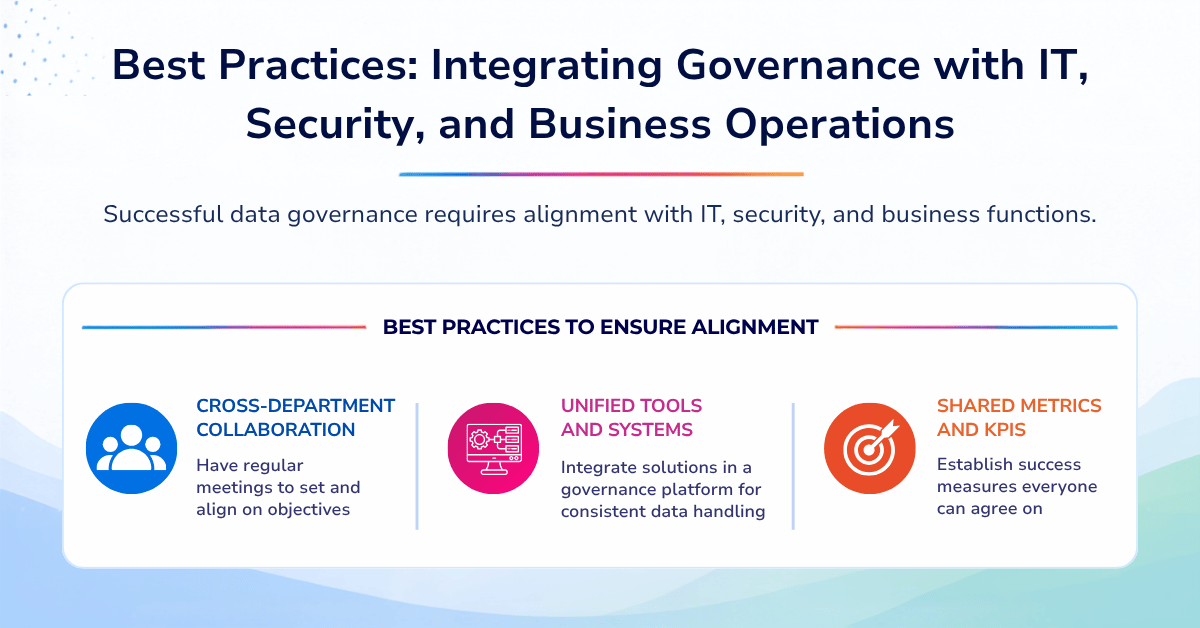
Successful data governance requires alignment with IT, security, and business functions.
The first step is establishing a shared governance culture with common goals and open communication across departments. Partnering with IT will help business functions to appropriate onboard governance solutions, while security teams can help identify risks early and implement appropriate controls.
Best practices to ensure alignment include:
-
Cross-Department Collaboration: Have regular meetings to set and align on objectives
-
Unified Tools and Systems: Integrate solutions in a governance platform for consistent data handling
-
Shared Metrics and KPIs: Establish success measures everyone can agree on
A cross-functional approach to data governance will help prevent data silos from developing, which would substantially hinder visibility and value realization from governance investments.
Conclusion: Preparing for the Next Era of Data Governance
The future of data governance promises both complexity and opportunity, but enterprises must adapt their frameworks to stay ahead.
By focusing on transparency and accountability, organizations can foster trust, safeguard data, and enhance decision-making, while taking advantage of policy-bound agents to help govern multi-cloud environments.
How CoreStack Supports Data Governance Frameworks
Everything covered in this guide, from policy-bound agents to compliance automation, is central to how CoreStack approaches governance. CoreStack enables enterprises to define policies once and enforce them continuously across systems.
Ready to modernize your data governance framework? Request a demo to see how CoreStack's Agentic Governance OS can help.
Frequently Asked Questions
What is a data governance framework for the cloud?
A data governance framework is a structured set of policies, roles, and processes that guide how an organization manages, protects, and uses its data across cloud environments.
What is the difference between data governance and data compliance?
Data governance is the broader practice of managing data quality, ownership, and access across an organization. Data compliance is one part of that practice, focused on regulatory and legal standards.
Why do enterprises need AI in data governance frameworks today?
AI strengthens data governance by automating repetitive tasks, improving data accuracy, and enabling real-time monitoring, which helps enterprises maintain strong compliance while reducing manual effort across complex multi-cloud environments.
What should enterprises prioritize when building a data governance model?
Enterprises should prioritize data transparency, clear ownership, consistent quality checks, and strong security, then layer in agentic AI to enforce policies continuously across every cloud platform they use.
Citations
-
The European Union (EU) General Data Protection Regulation (GDPR), University of Pittsburgh
↩ -
EU AI Act, European Commission, 2024
↩ -
Your Rights Under HIPAA, Department of Health and Human Services
↩


