

What Is CNAPP? Cloud-Native Application Protection Platform Explained
Cloud-native applications drive business agility, but they also bring unique security challenges. Here's what CNAPP is and why it matters.
In today's digital world, cloud-native applications are key to driving business agility and innovation, but they also bring unique security challenges that require attention.
Cloud-Native Application Protection Platforms (CNAPP) are a security solution built for cloud-native environments. It brings multiple security functions together into a single platform to give organizations a single solution to strengthen risk management and cloud protection across the entire application lifecycle.
Organizations face growing threats and compliance demands, especially as cyberattacks are increasingly using AI to increase their speed, scale, and personalization. CNAPP offers a unified solution to address these challenges by giving cloud and security teams greater visibility and control over complex multi-cloud environments.
Understanding CNAPP matters for CIOs, CISOs, and CFOs alike as it offers real business benefits for reducing risk and protecting profit margins. As cloud adoption grows, CNAPP is becoming essential for safeguarding multi-cloud environments and remediating vulnerabilities.
What Is CNAPP? A Cloud-Native Security Foundation
A Cloud-Native Application Protection Platform (CNAPP) brings several security capabilities together into one platform, giving organizations a unified way to manage risk and prioritize what needs to be remediated first.
CNAPP focuses on securing applications from development through deployment. Most CNAPP solutions, include workload and runtime protection, container security, cloud security posture management (CSPM) and real-time threat detection. This all-in-one approach helps enterprises eliminate blind spots and remediate vulnerabilities before they introduce security risks.
At the center of CNAPP's design is its ability to give deep visibility into cloud-native applications. This visibility is key for spotting vulnerabilities and misconfigurations. Better oversight helps cloud, SOC, and DevOps teams maintain compliance by continuously assessing configurations and workloads against common policy frameworks, including CIS, HIPAA, SOC 2, PCI DSS, ISO 27001, and NIST
Key components of a CNAPP solution include:
-
Workload Protection: Secures virtual machines and cloud resources.
-
Posture Management: Monitors and manages configurations to ensure they align with policies.
-
Runtime Security: Protects applications while they're running to detect and stop threats.
-
Container Security: Keeps containerized applications secure and intact.
For businesses running multi-cloud or hybrid environments, CNAPP provides consistent security controls, as well as the scalability and flexibility that dynamic cloud-native architectures need.
Why CNAPP Matters for Modern Enterprises
Enterprises across industries rely heavily on cloud-native applications to drive product innovation, customer retention, and business agility. CNAPP consolidates security functions into a single platform, eliminating the need for point solutions and reducing the cost and administrative burden of managing separate tools.
The proactive nature of CNAPP provides ongoing security monitoring across all cloud-native applications to ensure threats get flagged and remediated right away. It strengthens an organization's ability to manage security risk effectively.
For modern enterprises, staying compliant with industry regulations is critical to business operations and customer demands. CNAPP helps meet compliance standards through automated checks and assessments, making the path to regulatory adherence much easier.
Key benefits of implementing CNAPP include:
-
Reduced operational complexity with integrated tools.
-
Improved threat response time through continuous monitoring.
-
Enhanced compliance management with automated reporting and policy enforcement.
In short, CNAPP plays a key role in protecting business assets while enabling growth and resilience.
Key Components of a CNAPP Solution
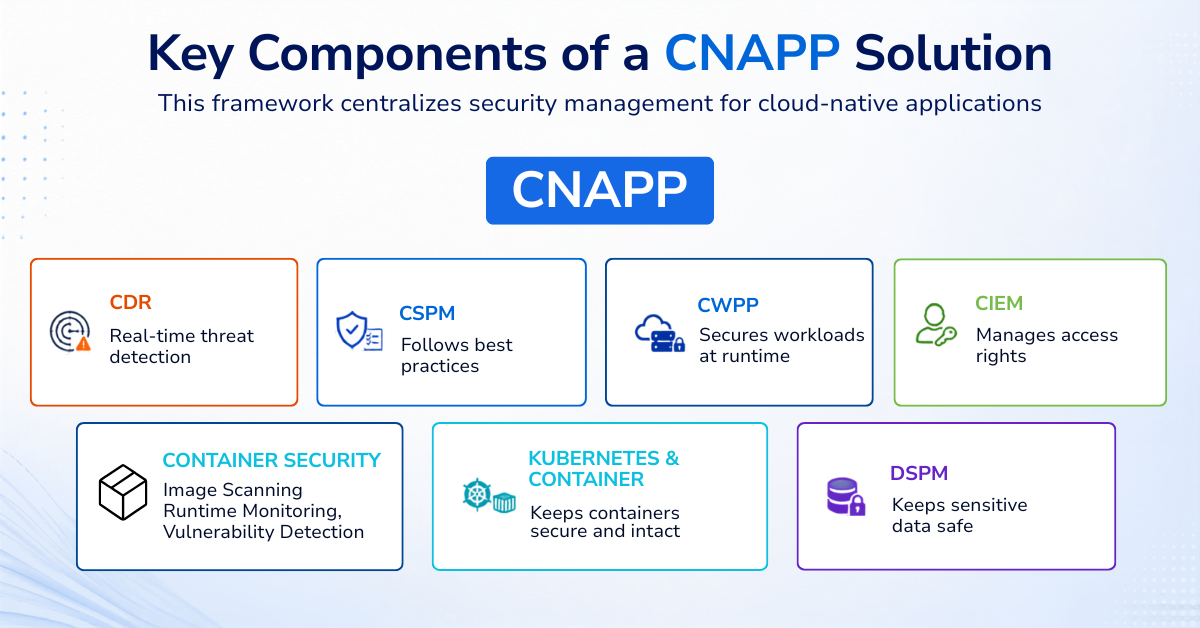
A CNAPP solution is comprehensive, bringing multiple security technologies together into one connected platform. This framework centralizes security management for cloud-native applications. At its core, CNAPP covers several layers of cloud security needs, including:
-
Cloud Security Posture Management (CSPM) ensures the cloud environment follows security policies and best practices.
-
Cloud Workload Protection Platforms (CWPP) secures workloads while they run.
-
Cloud Infrastructure Entitlement Management (CIEM) manages and governs access rights to cloud resources.
-
Kubernetes Security performs cluster configuration checks and drift detection.
-
Container Security performs image scanning, runtime monitoring, and vulnerability detection for containerized workloads.
-
Data Security Posture Management (DSPM) keeps sensitive data safe throughout its lifecycle by allowing organizations to track data assets and enforce policies. Cloud Detection & Response (CDR) offers real-time threat detection and response.
-
Cloud Detection & Response (CDR) offers real-time threat detection and response.
The breadth of a CNAPP solution gives organizations:
-
Unified management across all security aspects.
-
Streamlined compliance through automated controls.
-
Enhanced response capabilities through active monitoring and threat intelligence.
By combining these components, CNAPP solutions help enterprises maintain a strong, resilient security posture, that is designed to adapt quickly to the dynamic nature of modern cloud environments.
CNAPP vs CSPM: Understanding the Differences
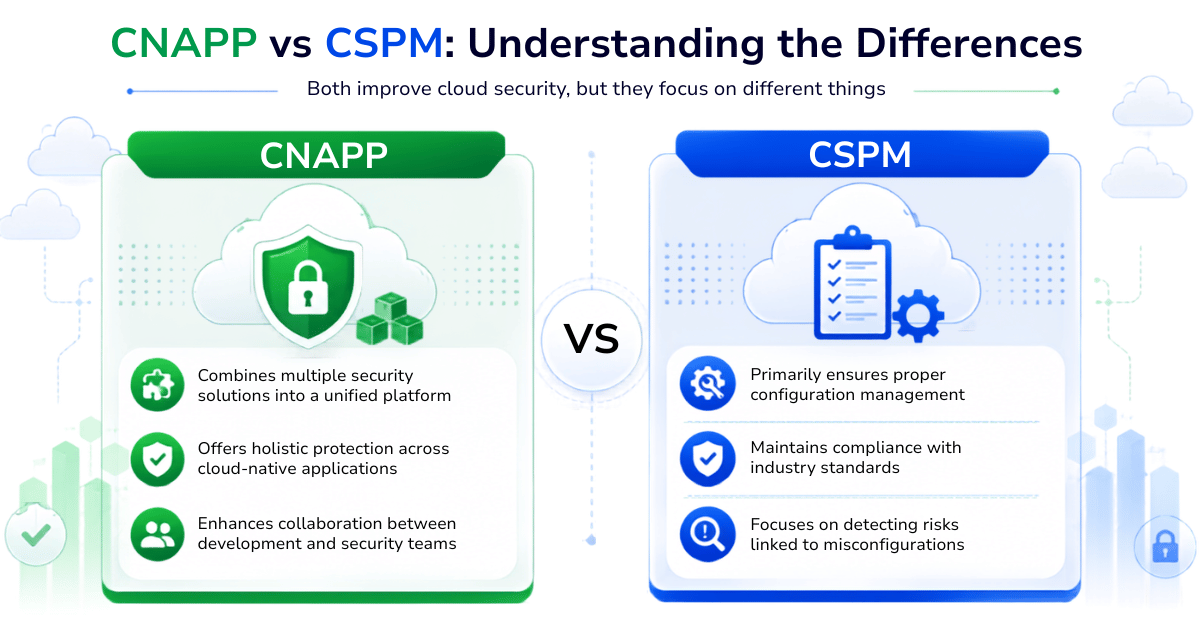
Understanding the different roles of CNAPP and CSPM matters to ensuring organizations select the most appropriate solution given their cloud environments. While both improve cloud security, they focus on different security functions.
CSPM concentrates mainly on configuration management and compliance. It checks cloud environments against best practices and standard frameworks. CSPM is great at catching configuration drift and securing cloud setups. For a closer look at how CSPM works on its own, see What Is CSPM?
CNAPP, on the other hand, integrates security across an application's entire lifecycle. It provides workload protection, threat detection, and even strengthens DevSecOps practices. Teams building those practices can start with these DevOps best practices for cloud teams. With CNAPP, organizations can address security at both the application and infrastructure level.
Key Points for CSPM:
-
Primarily ensures proper configuration management.
-
Maintains compliance with industry standards.
-
Focuses on detecting risks linked to misconfigurations.
Key Points for CNAPP:
-
Combines multiple security solutions into a unified platform.
-
Offers holistic protection across cloud-native applications.
-
Enhances collaboration between engineering and security teams.
How CNAPP Tools Work: Policy, Automation, and Integration
CNAPP tools work by weaving policy, automation, and integration together. They start with clearly defined security policies, which guide the system's actions across cloud environments.
Automation is central to CNAPP as it reduces manual work and improves accuracy. Automated processes and AI-powered detection surfaces threats more quickly and allows security teams to respond faster to findings before they become incidents.
Integration capabilities allow CNAPP tools to operate seamlessly across different cloud services. They work alongside existing security setups, much like how infrastructure as code supports DevOps at scale, creating one seamless ecosystem.
Continuously applying relevant policy frameworks drives consistent security practices and helps to align cloud operations with compliance requirements.
As CNAPP tools evolve, they improve collaboration between IT and security teams, leading to better, faster risk-based decisions based on real, actionable insights.
Economic Impact: Cost, Risk, and Margin
Implementing CNAPP solutions helps organizations control cloud costs, reduce risks, and safeguard critical systems needed to ensure business continuity.
By optimizing security processes, CNAPP tools deliver material financial benefits, in much the same way that strong cloud cost management practices deliver financial benefits on the FinOps side of the house.
CNAPP tools reduce the need for multiple point solutions, which reduces the costs and time associated with procuring, deploying, and managing multiple vendors.
CNAPP solutions strengthen threat detection and response. By proactively managing vulnerabilities, organizations limit the potential damage from security breaches and can quickly remediate vulnerabilities.
Finally, ensuring clouds environments remain operational is essential to keeping modern enterprises functioning. CNAPP tools help maintain business continuity, protecting the bottom line.
Best Practices for CNAPP Implementation
Implementing CNAPP successfully takes strategic planning and execution across teams, including IT, security, cloud, and finance. Start by assessing your current cloud security posture to identify gaps and vulnerabilities. It often helps to follow common cloud governance best practices to make the assessment and subsequent security rollout easier.
Onboarding a CNAPP solution smoothly depends on coordinating closely with all stakeholders. Bring key teams in from the start, to ensure that everyone is aligned on priorities and goals.
After you've set a clear strategy, focus on selecting the right solution based on your organization's cloud environment and business needs. Make sure whatever solution you select can support scalability as your infrastructure grows.
Considerations for Selection:
-
Integration Capabilities: Must work with existing systems and cloud providers.
-
User-Friendliness: Ensure it's easy to use across different teams.
-
Deployment Model: Understand how the product will be deployed (ex: SaaS subscription or enterprise license)
A successful CNAPP implementation strengthens security without slowing innovation. By following these best practices, you can protect cloud-native applications more effectively while preserving the agility teams need to move fast.
The Future of CNAPP: AI, Automation, and Continuous Governance
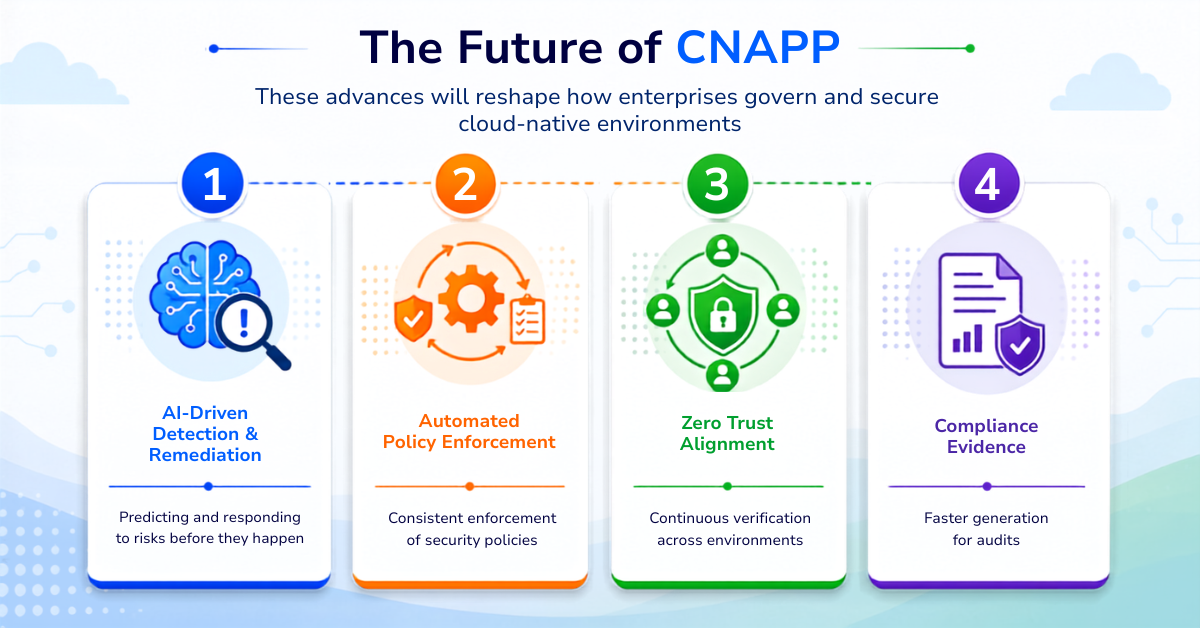
The future of CNAPP is closely tied to advances in AI and automation. These technologies are set to strengthen proactive threat detection, letting security systems predict and respond to risks before they happen, a shift already visible in Graphion's release last year.
Expected Developments in CNAPP:
-
AI-driven threat detection and remediation
-
Automated policy enforcement
-
Zero trust alignment for continuous verification
-
Faster compliance evidence generation
These advances will reshape how enterprises govern and secure cloud-native environments, offering more robust, dynamic protection.
Conclusion: Building Resilience with CNAPP
CNAPP solutions offer a unified approach to securing cloud-native environments against evolving threats.
As cloud environments grow more complex, CNAPP solutions will help organizations take a proactive approach to securing infrastructure and applications, while allowing teams to continue innovating without compromising security.
How Graphion Delivers CNAPP for the Modern Enterprise
Graphion helps security teams reduce cloud risk and remediate vulnerabilities. Powered by a proprietary graph-based intelligence model (CloudKM) that maps relationships across applications, containers, and workloads, Graphion fuses technical signals with business context to help engineering, SOC, and DevOps teams strengthen security posture by turning fragmented cloud risks into prioritized, actionable decisions.
Graphion ingests SBOMs for build-over-build visibility, mapping component risk and dependency relationships across a unified inventory of assets, configurations, and access permissions. The knowledge graph then correlates every SBOM and IBOM element into one queryable source of truth, surfacing vulnerabilities, misconfigurations, and access risks, so teams know which vulnerabilities to remediate first based on business impact.
Ready to see Graphion in action? Book a demo to see how Graphion can strengthen your cloud security posture.
Frequently Asked Questions
What is CNAPP used for in cloud security today?
CNAPP, or Cloud-Native Application Protection Platform, is a security solution category that combines multiple cloud security functions, like posture management, workload protection, and access control, into a single platform to protect applications across their entire lifecycle.
What is the difference between CNAPP and CSPM?
CSPM focuses specifically on configuration management and compliance, checking cloud environments against best practices. CNAPP is broader: it includes CSPM as one component alongside workload protection, entitlement management, container security, and threat detection, covering the full application lifecycle rather than just configuration.
What are the main components of a CNAPP tool?
A typical CNAPP tool combines Cloud Security Posture Management (CSPM), Cloud Workload Protection Platform (CWPP), Cloud Infrastructure Entitlement Management (CIEM), Kubernetes and container security, Data Security Posture Management (DSPM), and Cloud Detection and Response (CDR) into one unified platform.
Why do enterprises still need CNAPP tools today?
Enterprises need CNAPP tools to reduce the complexity of managing multiple disconnected security solutions, gain full visibility across cloud-native applications, and respond faster to threats, all while supporting compliance and protecting profit margins as cloud adoption grows.


