

CloudOps Explained: Cloud Architecture Patterns, Best Practices, and Governance
Cloud architecture provides the strategic blueprint for deploying and managing cloud resources effectively. Here's how architecture, best practices, and governance come together in CloudOps.
Cloud architecture provides the strategic blueprint for deploying and managing cloud resources effectively. Understanding its patterns and best practices is crucial for any organization.
In today's fast-paced business environment, cloud operations (CloudOps) must be efficient and resilient. This requires a deep understanding of cloud architecture best practices, which ensure scalability, security, and compliance.
Governance plays a pivotal role in cloud architecture, helping cloud operations align with business goals and regulatory requirements. Effective governance reduces risk, especially in multi-cloud environments where configuration drift can introduce exposure, and optimizes costs.
CloudOps focuses on increasing operational efficiency and continuous improvement by leveraging automation and policy-driven management to increase reliability after an application has been deployed.
Organizations can measure the economic impact of CloudOps through cost savings, risk reduction, and margin protection.
What Is Cloud Architecture? Foundations and Business Value
Cloud architecture forms the strategic backbone of cloud infrastructure. It defines the components and relationships for how cloud-based environments are designed and connected across components, including compute power, storage capacity, database relationships, and networking.
The foundation of cloud architecture is its ability to abstract and virtualize resources. This abstraction enables organizations to deploy applications flexibly and scale resources according to demand, which simplifies the cost and time management of complex systems.
Organizations can achieve significant business outcomes through a well-designed cloud architecture. Key benefits include:
-
Scalability: Dynamically adjust resources to meet changing demands.
-
Flexibility: Deploy and manage applications across different environments.
-
Protection: Safeguard data using segmentation, access controls, and logging.
A well-designed cloud architecture supports both public and private cloud solutions. This duality enables businesses to tailor their cloud strategies to specific needs, thereby maximizing economic impact and ensuring business continuity.
Key Cloud Architecture Patterns: Microservices, Serverless, and Beyond
Cloud architecture patterns guide the deployment and management of applications by providing blueprints that can be easily used to solve commons problems, such as managing spikes in traffic or legacy systems.
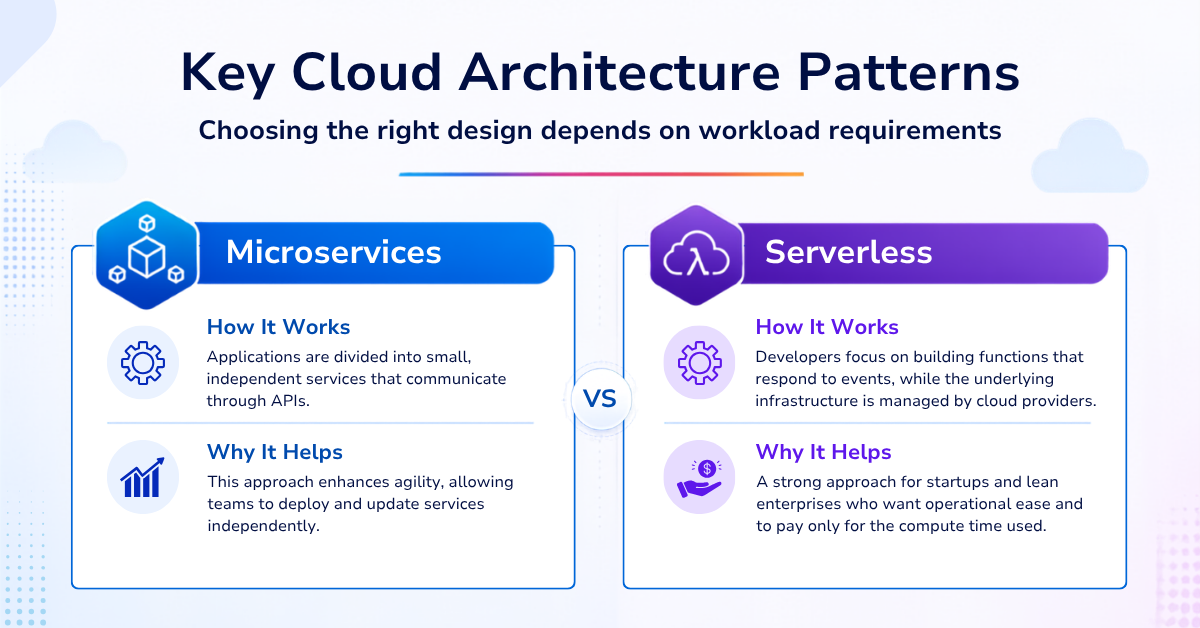
Microservices represent one of the most popular cloud architecture approaches. Applications are divided into small, independent services that communicate through Application Programming Interfaces (APIs). This approach enhances agility, allowing teams to deploy and update services independently, which can be helpful if they are managing a large product that offers multiple deployment models.
Serverless architecture is another popular option where developers focus on building functions that respond to events, while the underlying infrastructure is managed by cloud providers. This can be a strong design approach for startups and lean enterprises who may be looking for operational ease and only want to pay for the compute time used to save money.
Beyond microservices and serverless, organizations can also explore containerization. Containers package applications and their dependencies, ensuring consistency across environments.
Choosing the right design depends on workload requirements, as well as service requirements such as scalability, complexity, and time-to-market. Making a strategic selection ensures that the cloud architecture your enterprise chooses supports both current and future business goals.
Cloud Architecture Best Practices: Scalability, Resilience, and Security
Adopting best practices in designing cloud architecture enhances system performance and reliability by making sure that cloud solutions can scale, remain resilient, and stay secure.
Scalability involves designing systems that can grow with demand based on computing needs. Key scalability features include:
-
Elasticity: Automatically adjust resources based on traffic.
-
Load Balancing: Distribute incoming traffic to multiple resources to prevent overload.
-
Observability: Collect metrics and logging to identify bottlenecks.
Building resilience into your architecture is crucial. Systems should be able to handle unexpected outages without major disruptions that could impact revenue-generating business functions. Effective resilience strategies include:
-
Redundancy: Deploy duplicate resources to avoid single points of failure.
-
Disaster Recovery: Document recovery approaches to quickly help teams restore systems after interruptions.
Security is foundational to cloud architecture. Ensuring confidentiality, integrity, and availability of data is paramount. Make sure to design architecture with cloud security as a primary concern, rather than an afterthought. Cloud security posture management (CSPM) plays a central role here, continuously checking that architecture stays configured the way it was designed.
Best practices for cloud security include:
-
Identity Management: Use robust authentication and authorization tools.
-
Data Encryption: Encrypt data in transit and at rest to protect sensitive information.
-
Centralize Logs: Integrate monitoring and logging into SOAR solutions or internal workflows to ensure ongoing visibility and access.
Governance in Cloud Architecture: Policy, Compliance, and Risk Management
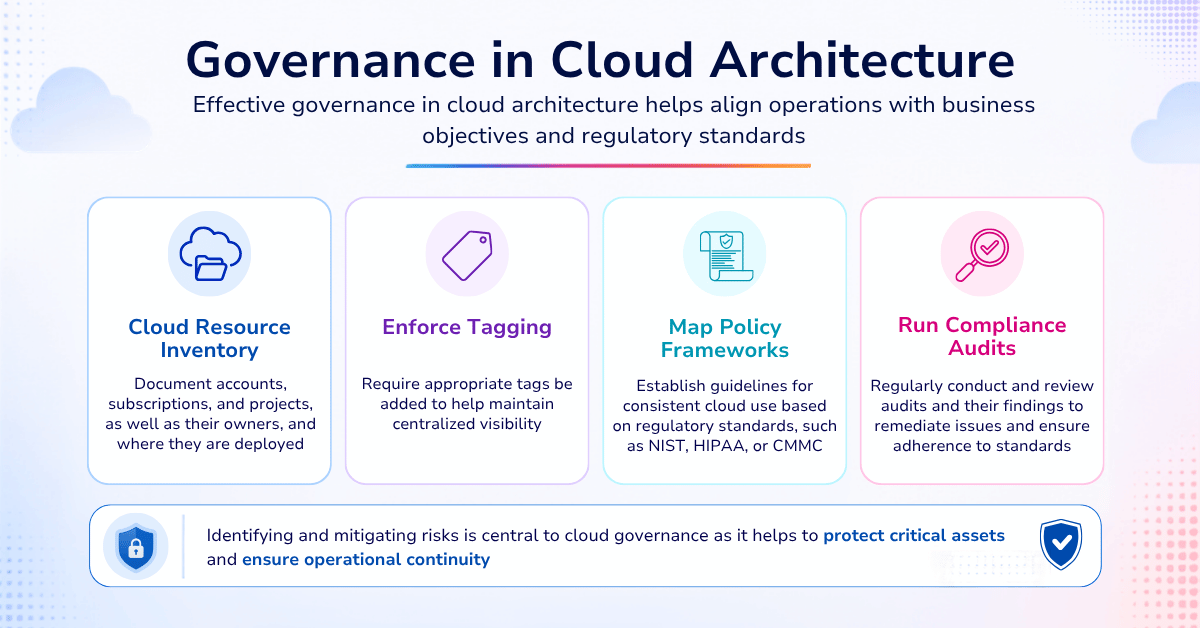
Effective governance in cloud architecture helps align operations with business objectives and regulatory standards by setting rules, creating procedures, and defining accountability frameworks to maintain compliance, especially in heavily regulated industries, like healthcare, banking, and manufacturing.
A strong governance approach helps protect organizations from regulatory breaches and associated penalties. Key aspects of a strong and centralized cloud governance framework include:
-
Creating a Cloud Resource Inventory: Document accounts, subscriptions, and projects, as well as their owners, and where they are deployed.
-
Enforce Tagging: Require appropriate tags be added to help maintain centralized visibility.
-
Map Policy Frameworks: Establish guidelines for consistent cloud use based on regulatory standards, such as NIST, HIPAA, or CMMC.
-
Run Compliance Audits: Regularly conduct and review audits and their findings to remediate issues and ensure adherence to standards.
Identifying and mitigating risks is central to cloud governance as it helps to protect critical assets and ensure operational continuity.
Policy-bound agents can help teams automate routine governance tasks. These agents enforce policies and compliance checks efficiently, helping to reduce manual workloads and increase response speeds. Governance frameworks should evolve alongside technology and organizational changes to accommodate new regulations and emerging threats.
Cloud Operations: Driving Efficiency and Continuous Improvement
CloudOps optimizes cloud deployment and management by automating processes and enhancing operational effectiveness across environments. With CloudOps, businesses can help streamline routine governance activities and reduce manual errors.
Core components of effective CloudOps include:
-
Automation: Leverage automation or AI agents to reduce manual errors and speed up routine tasks.
-
Monitoring: Keep a constant eye on performance and resource availability.
-
Collaboration: Ensure IT and business units work together to manage cloud resources within approved budgets.
Automation can help teams streamline processes and reduce manual, redundant work. Policy-bound agents, for instance, can run compliance checks, ensuring consistent adherence to standards. Monitoring and logging tools provide IT and FinOps teams with insights into resource utilization and potential issues, allowing swift corrective actions that maintain high service availability. The delivery practices that feed these operations are covered in DevOps best practices for cloud teams.
The Economic Impact of CloudOps
In the current environment of ever-increasing cloud costs, tying tangible economic outcomes to cloud investments is crucial to justifying increasing budgets. CloudOps translates technical decisions into business value through cost optimization, meaningful risk reduction, and margin protection.
Cost optimization helps efficiently manage cloud resources through right-sizing resources and by leveraging automation to prevent cost anomalies from eroding margins.
Risk reduction focuses on mitigating potential threats, which could lead to costly security incidents. A robust cloud architecture includes comprehensive security measures, such as workload protection, configuration management, and regular compliance audits that check for vulnerabilities and help maintain operational integrity.
Margin protection is achieved through strategic planning and execution to help prevent costly budget overruns.
Implementing an AI-Led Governance Framework: Policy-Bound Agents and Automation
Creating an effective AI-powered governance framework in cloud architecture helps maintain continuous compliance. It involves the use of policy-bound agents and automated workflows to streamline operations.
Policy-bound agents act as digital administrators by adhering to predefined rules and guidelines. They work continuously to extend your IT team's capacity, ensuring cloud environments remain within regulatory boundaries.
Automation also plays a crucial role in reducing manual oversight. By automating routine governance tasks, such tagging, organizations can minimize errors and free up internal resources to work on more strategic and time-consuming projects.
Future-Proofing Cloud Architecture: Adaptability and Continuous Learning
To ensure your cloud architecture remains adaptable as the technology landscape changes, it's a good idea to embrace a culture of continuous learning. This helps teams stay equipped with the latest knowledge and skills through ongoing training and upskilling.
Organizations should foster a learning culture that embraces innovation. Experimentation with new solutions can lead to significant advantages, so consider providing IT teams with an experimental budget that they can tap into to test out new tools and approaches in a secure environment. A future-proof cloud architecture approach should incorporate:
-
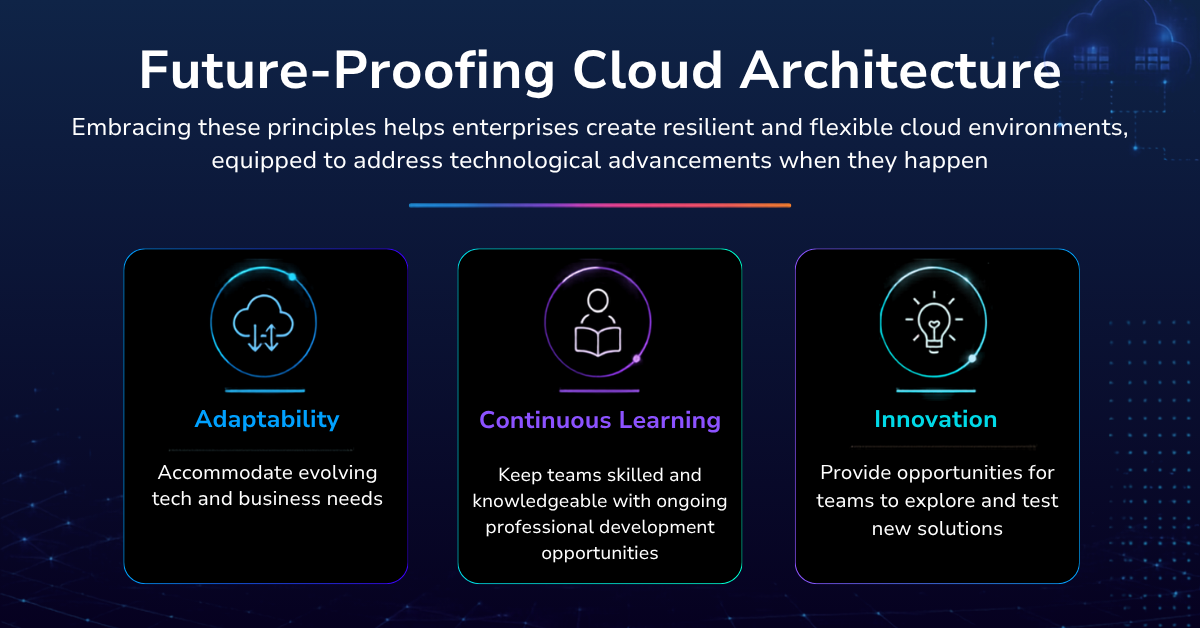
Adaptability: Accommodate evolving tech and business needs.
-
Continuous Learning: Keep teams skilled and knowledgeable with ongoing professional development opportunities.
-
Innovation: Provide opportunities for teams to explore and test new solutions.
Embracing these principles helps enterprises create resilient and flexible cloud environments, equipped to address technological advancements when they happen.
Conclusion: Aligning Cloud Architecture with Strategic Business Outcomes
Cloud architecture should evolve with your organization's needs. By maintaining a focus on governance, focusing your team's resources on implementing best practices, and providing a supportive culture to encourage innovation, enterprises can enhance their cloud architecture, drive operational efficiency, and strengthen business outcomes.
How CoreStack CloudOps Brought This Guide to Life
Every practice covered here, from resilient patterns to governance frameworks and policy-bound automation, is exactly what CoreStack CloudOps is built to deliver. A key module in our FinOps+ product, which helps organizations optimize and govern multi-cloud spend, CloudOps combines rule-based automation, real-time monitoring, tagging governance, and anomaly detection into a unified solution, keeping cloud infrastructure and applications running smoothly across complex cloud environments.
Ready to put these practices into action? Book a demo to see how CoreStack CloudOps can streamline your cloud operations.
Frequently Asked Questions
What is CloudOps and why does it matter?
CloudOps, or Cloud Operations, is the practice of managing and optimizing cloud infrastructure and applications through automation, monitoring, and policy-driven processes to improve efficiency and reliability.
What's the difference between cloud architecture and CloudOps?
Cloud architecture is the strategic design and structure of cloud environments, including patterns like microservices and serverless. CloudOps is the ongoing operational practice of running, monitoring, and optimizing that architecture day to day.
What are the best practices for cloud architecture?
Key best practices include designing for scalability with auto-scaling and load balancing, building resilience through redundancy and disaster recovery, and prioritizing security with identity management and data encryption.
Why does cloud governance matter for cloud architecture?
Governance ensures cloud operations align with business goals and regulatory requirements, reducing risk and controlling costs through policy frameworks, compliance audits, and automated enforcement.


