

CapEx vs OpEx in Cloud: What Every Finance and IT Team Needs to Know
Navigating the financial side of cloud computing starts with understanding CapEx and OpEx, and how each shapes your cloud cost management strategy.
Navigating the financial side of cloud computing starts with understanding CapEx and OpEx. These terms define how organizations plan and pay for their IT budgets. CapEx, or Capital Expenditure, means paying upfront for physical assets. OpEx, or Operational Expenditure, covers ongoing costs for services and maintenance.
In the cloud, shifting from CapEx to OpEx gives businesses more flexibility and room to grow, and changes how they manage IT costs. This shift affects financial statements, cash flow, and long-term planning. Finance and IT teams both need to understand these effects.
Cloud cost analysis becomes essential in this context as it helps organizations see the full financial picture of their cloud investments. The choice between CapEx and OpEx affects taxes, accounting, and reporting. It also shapes how fast they can innovate and adapt.
Finance and IT leaders need to work together to align cloud spending with business goals. This teamwork makes sure cloud investments support the bigger strategy. Strong cloud cost management practices help control and optimize OpEx spending, giving teams the guardrails they need to avoid cost overruns.
The move to OpEx can boost business agility as it lets teams scale resources up or down quickly to match demand. However, it's critical for organizations to balance that flexibility against the risk of unpredictable costs. Revisiting CapEx vs OpEx decisions regularly is key to staying aligned as the business and technology landscape changes.
Understanding CapEx and OpEx: Definitions and Core Differences
CapEx and OpEx are terms every finance and IT professional should know well. CapEx refers to funds a company uses to buy, upgrade, and maintain physical assets like servers and data centers. These costs are significant and usually require long-term planning and budgeting.
OpEx, on the other hand, covers expenses needed for the day-to-day running of a business. These costs include ongoing items like cloud service subscriptions.
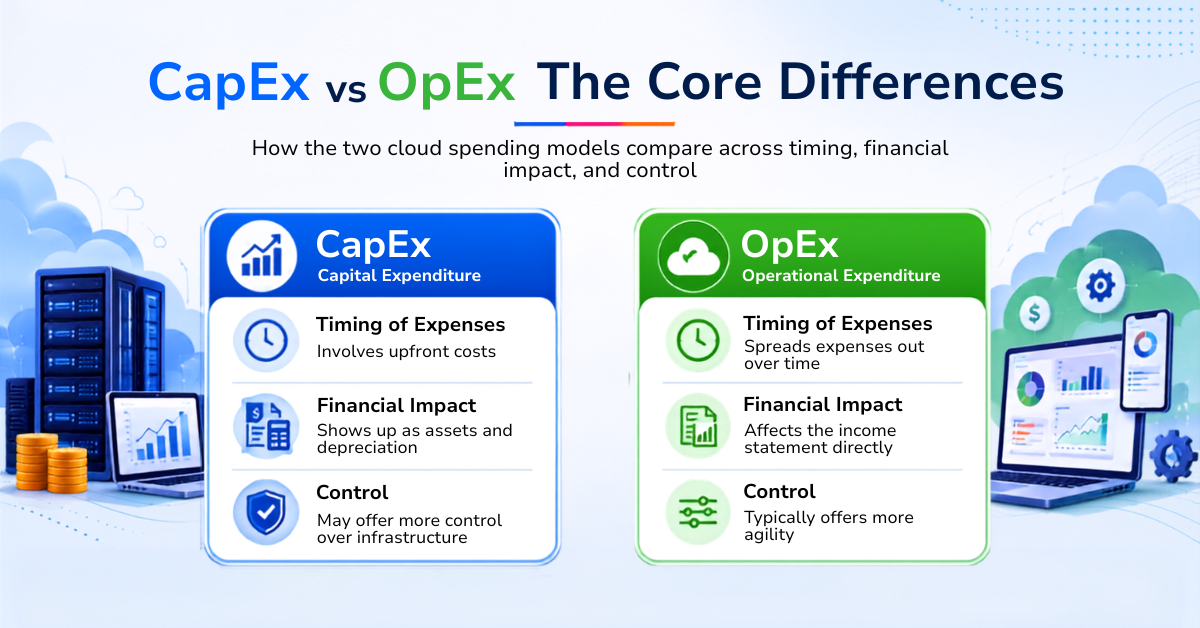
The main differences between CapEx and OpEx can be summed up as follows:
-
Timing of Expenses: CapEx involves upfront costs while OpEx spreads expenses out over time.
-
Financial Impact: CapEx investments show up as assets and depreciation while OpEx affects the income statement differently.
-
Control: CapEx may offer more control over infrastructure while OpEx typically offers more agility.
Organizations traditionally relied on CapEx to manage IT infrastructure. Today, the cloud makes it easier to shift toward OpEx as this shift lets businesses respond faster to change. Knowing when to use CapEx or OpEx models can make a real difference in how an organization performs. It's important to look closely at business needs and financial limits. Doing so helps finance and IT teams work together and make better-informed decisions.
CapEx in Cloud: Characteristics, Examples, and Challenges
CapEx in a cloud context still has some unique traits. Unlike traditional IT spending, cloud-based CapEx can still involve upfront costs, though usually less than buying full hardware. These costs might include setting up private cloud infrastructure or leasing dedicated servers from a cloud provider.
Examples of CapEx investments in the cloud include buying hardware or locking in long-term capacity reservations. Organizations often invest in hybrid cloud models that combine on-premises infrastructure with public cloud resources, an approach that involves the kind of multi-cloud complexity that requires careful planning across providers.
Challenges with CapEx in cloud scenarios come in several forms. Initial costs can be high, which requires careful budget planning or else risks straining financial resources if they not aligned with long-term business goals. On top of that, owned assets can lose value over time, which affects financial statements.
Managing CapEx in cloud environments takes real effort. IT teams must accurately predict future needs, which isn't easy, especially as the cost of AI tokens adds a new layer of cost anomalies to many cloud budgets. Overestimating or underestimating capacity needs can lead to waste or inefficiency.
Key characteristics and challenges include:
-
Initial Investment: Requires a significant amount of capital.
-
Ownership and Control: Greater control over infrastructure, but requires resources for management and upkeep.
-
Financial Impact: Affects balance sheets through asset depreciation.
Despite these challenges, CapEx can offer long-term value for certain businesses. Companies with steady demand and clear growth plans might find CapEx investments worthwhile. Still, they need to weigh these benefits against the flexibility and scalability that OpEx models offer.
OpEx in Cloud: Characteristics, Examples, and Challenges
Operational Expenditure (OpEx) in cloud computing offers a flexible financial model that lets enterprises pay only for what they use, which supports cost-effectiveness and adaptability. This model fits well with how fast cloud services change.
Examples of OpEx in the cloud include subscription-based services, pay-as-you-go pricing, and cloud provider-managed services. Businesses can start small and scale up based on demand, which cuts down on waste. This model supports fast growth and adapts easily to changing business needs.
OpEx in the cloud also brings real challenges. Cost predictability can be tough because of usage-based billing. This can lead to surprisingly high bills if usage spikes aren't closely watched. Enterprises need effective monitoring tools and strong approach to cloud governance to catch these anomalies early.
With OpEx, enterprises also give up some control over IT resources. Relying on service providers for core infrastructure can raise concerns about availability, performance, and compliance. These concerns call for strong cloud governance frameworks to manage risk.
OpEx is also valued for improving cash flow. Unlike CapEx, expenses spread out over time, which eases budget pressure, especially for enterprises looking to scale quickly. This flexibility also supports innovation by freeing up funds for new projects without needing a large upfront investment.
Key characteristics and challenges of OpEx include:
-
Cost Flexibility: Spending adjusts dynamically with usage.
-
Financial Management: Easier to spread costs out over time.
-
Risk and Control: Greater reliance on cloud service providers for infrastructure needs.
The OpEx model fits well with strategic goals where flexibility and fast scaling matter most, but adopting it calls for a strong focus on cost monitoring and governance to manage risk.
Financial Impact: How CapEx vs OpEx Shapes Cloud Cost Management
The financial impact of CapEx versus OpEx runs deep when it comes to cloud cost analysis. These models affect budgeting, cash flow, and overall financial strategy in different ways, so it's critical for Finance teams to understand these impacts clearly.
CapEx requires large initial investments to acquire physical assets like servers. These investments affect cash flow right away but can offer predictable depreciation rates over time.
OpEx, by contrast, turns IT spending into smaller, ongoing costs. This model allows for flexible financial planning by spreading expenses evenly over time. It improves cash flow and makes budget management easier.
Cloud cost analysis requires careful thought about both expenditure types. CapEx decisions usually involve a longer-term commitment. The assets acquired might take years to pay off, which requires patience and careful forecasting. OpEx, however, brings variability through usage-based billing. This calls for active cost analysis and steady monitoring to prevent going over budget.
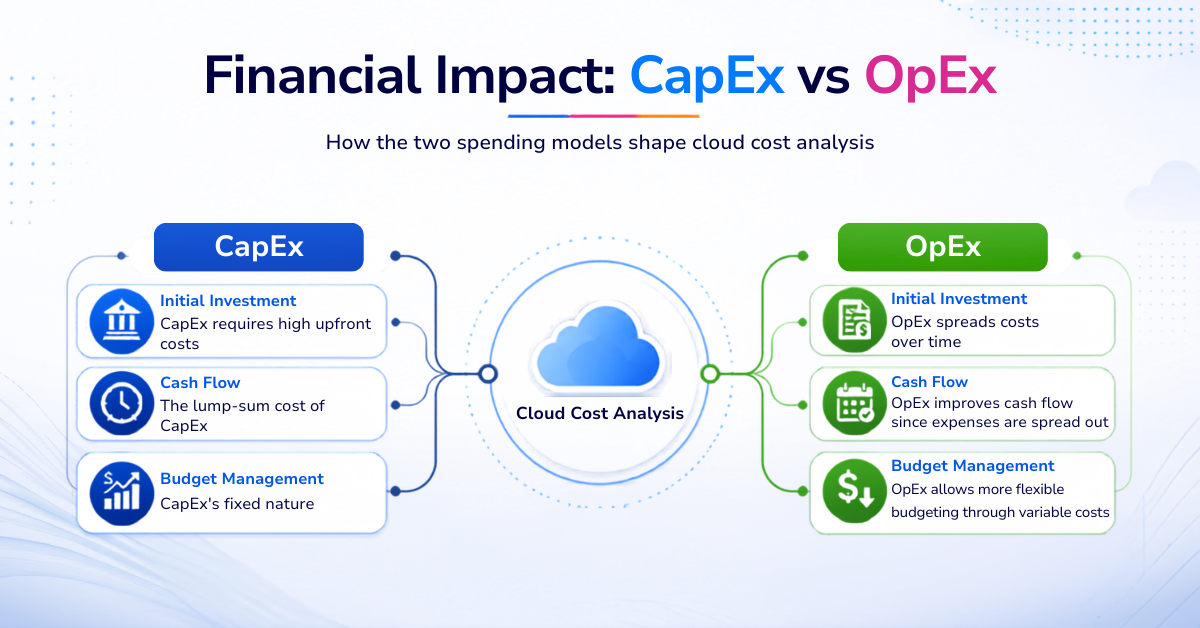
Key financial impacts of CapEx versus OpEx include:
-
Initial Investment: CapEx requires high upfront costs, while OpEx spreads costs over time.
-
Cash Flow: OpEx improves cash flow since expenses are spread out, unlike the lump-sum cost of CapEx.
-
Budget Management: OpEx allows more flexible budgeting through variable costs, unlike CapEx's fixed nature.
Aligning cloud spend with business goals helps organizations get the most out of cloud technology, while managing the financial side effectively.
Cloud Cost Analysis: Tools, Metrics, and Best Practices
Effective cloud cost analysis is key to optimizing cloud expenses. It gives both IT and Finance teams insights into usage patterns, helping control both CapEx and OpEx.
Cloud financial management solutions break down cloud costs in detail and offer real-time analytics and forecasts, supporting better decision-making and financial planning to optimize cloud spend.
Common metrics enterprises track to understand their cloud ROI include Total Cost of Ownership (TCO), cost by provider, and cost per workload. Tracking these metrics helps FinOps teams, who manage cloud costs within an organization, identify cost-saving opportunities. Running a FinOps maturity assessment is a good way to benchmark where your organization stands before setting improvement goals.
Essential best practices for cloud cost management include:
-
Regular Audits: Schedule routine checks to identify unnecessary expenses.
-
Resource Tagging: Use tags to sort spending by department or project.
-
Budget Alerts: Set alerts to notify when expenses get close to set limits.
By using a cloud financial management solution, tracking metrics, and following best practices, organizations can optimize cloud spending. This alignment makes sure cloud expenses support business goals while minimizing financial loss.
Strategic Considerations: Aligning CapEx/OpEx with Business Objectives
The choice between CapEx and OpEx should be shaped by the organization's bigger goals to ensure financial practices support long-term growth.
Enterprises must decide whether innovation or stability is the main focus, which shapes whether to invest in material assets like infrastructure or operational flexibility.
CapEx decisions often reflect a commitment to control and ownership. These investments typically support stability and may work better for companies with strong cash reserves and more predictability.
OpEx, by contrast, fits enterprises who need to prioritize agility and scalability. By choosing operational expenditure, organizations can adapt quickly to changing market conditions, which can be a real advantage in quickly changing industries like biotechnology, FinTech, healthcare, and renewable energy where new tools arrive often and regulations are still evolving to meet public needs.
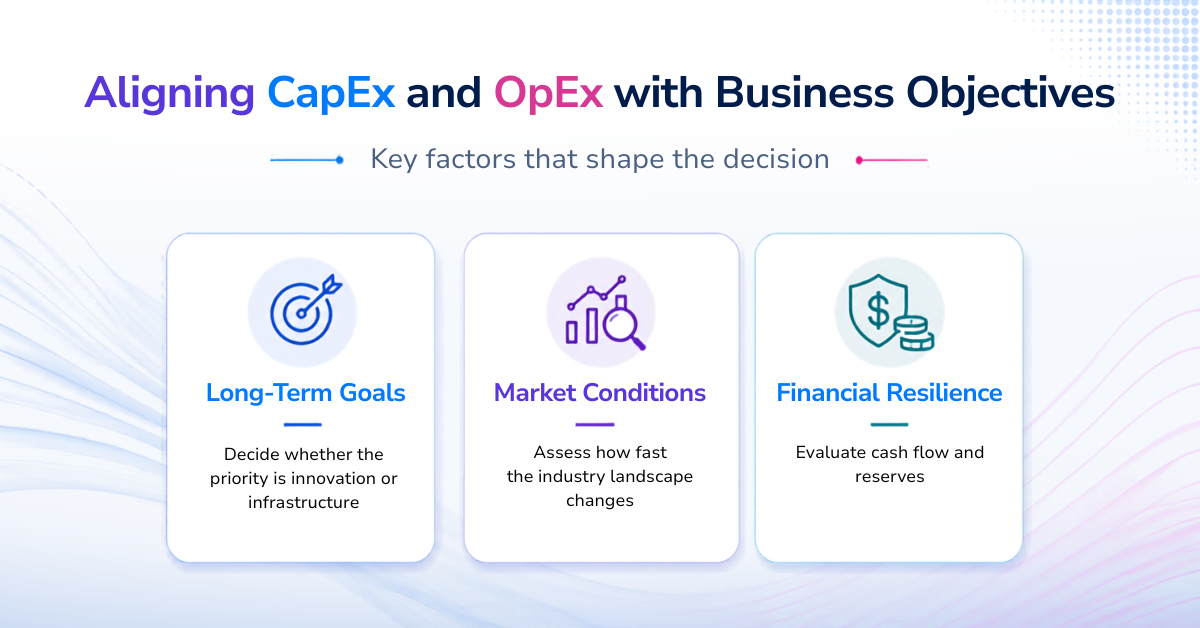
To align CapEx/OpEx with business goals, consider the following:
-
Long-term Goals: Decide whether the priority is innovation or material assets.
-
Market Conditions: Assess how fast the industry landscape changes.
-
Financial Resilience: Evaluate cash flow and reserves.
By carefully weighing these factors, organizations can make informed CapEx/OpEx decisions. Building a strong FinOps practice helps ensure financial models support both day-to-day operations and long-term success. This balance between investment and expenditure is critical for thriving in a fast-changing market.
Governance and Policy: Managing Cloud Spend Across CapEx and OpEx
Strong governance is crucial for managing cloud finances. A structured approach keeps spending aligned with business goals, while maintaining cost-efficiency and compliance across an organization.
In designing a cloud governance approach, setting clear policies is essential. These policies should allow organizations to adhere to relevant regulatory requirements and guide decisions related to both CapEx and OpEx. This keeps financial practices consistent and accountable without introducing compliance risks.
Balancing CapEx and OpEx takes ongoing oversight and commitment across cross-functional teams, including IT, Cloud, Finance, and FinOps. Regularly reviewing cloud expenses helps identify inefficiencies, which makes it possible to quickly adjust and optimize resource allocation, including catching unusual spending through cost anomaly detection before it becomes a bigger problem.
Organizational policies should cover several key areas:
-
Budgeting and Forecasting: Define frameworks for predicting and allocating costs.
-
Cost Monitoring: Implement robust solutions to track and report on cloud spend.
-
Compliance and Risk Management: Ensure adherence to regulatory requirements and reduce potential risks. For security-specific spend, tools like CNAPP platforms bring the same kind of governance discipline to compliance and risk management that FinOps brings to cost.
Financial governance is only part of the picture; pairing it with strong data governance frameworks ensures the data behind every CapEx and OpEx decision is trustworthy too.
By putting strong governance and policy frameworks in place, organizations can better manage cloud spend to strengthen financial performance and strategic agility.
Key Takeaways for Finance and IT Leaders
Working through the CapEx vs OpEx decision takes strategic foresight and alignment with business goals. The choice between these financial models has far-reaching effects on cost management and operational agility. Leaders must make sure both finance and IT perspectives shape this process.
Financial leaders should focus on how these models affect cash flow, tax implications, and financial reporting. It's important to consider how a shift to OpEx can improve flexibility, but might require closer cost monitoring.
IT leaders, meanwhile, need to focus on the technology and operational benefits. Adopting OpEx models can speed up innovation and scalability, but they also need to watch for risks like uncontrolled spending.
Key Points for Consideration:
-
Collaborate across departments for informed decision-making.
-
Monitor and manage expenditure to avoid financial waste.
-
Regularly assess strategies to respond to evolving business environments.
Leaders need to balance short-term needs with their long-term vision. This means thoroughly analyzing CapEx and OpEx options to support sustainable growth and a competitive edge.
How CoreStack Supports CapEx and OpEx Decision-Making
Every decision covered in this guide, from weighing CapEx investments to managing variable OpEx spend, depends on having clear, real-time visibility into cloud costs. CoreStack FinOps+ gives finance and IT teams that visibility across all major cloud providers, including AWS, Azure, Google Cloud, and Oracle Cloud and delivers FOCUS-compliant cost reporting, AI-powered anomaly detection, and automated forecasting, so leaders can see exactly how spending is tracking against budgets in real time. Built-in chargeback and showback features also make it easier to allocate costs by department or project, turning the governance and policy practices described above into daily operational habits.
Ready to bring clarity to your cloud management decisions? Request a demo to see how CoreStack FinOps+ can help your finance and IT teams align cloud spending with business goals.
Frequently Asked Questions
What is the difference between CapEx and OpEx in cloud computing?
CapEx involves upfront spending on physical assets, like servers or data centers, while OpEx covers ongoing, pay-as-you-go costs like cloud subscriptions. Cloud computing generally shifts spending from CapEx to OpEx.
Is cloud computing CapEx or OpEx?
Most public cloud spending is treated as OpEx, since you pay for what you use on an ongoing basis. However, some cloud investments, like long-term capacity reservations or private cloud infrastructure, can still count as CapEx.
Why do companies prefer OpEx over CapEx for cloud spending?
OpEx offers more flexibility, improves cash flow by spreading costs over time, and allows businesses to scale spending up or down based on actual demand, rather than committing to a large upfront investment.
How does cloud cost analysis help with CapEx vs OpEx decisions?
Cloud cost analysis gives finance and IT teams the visibility they need to see how spending breaks down between CapEx and OpEx, track key metrics and make more informed decisions about future investments.


