
Top 10 Cost Anomaly Trends in the Modern Cloud Era
By: Sabapathy Arumugam, Chief Technology Officer
In today’s cloud driven world, cost anomalies can escalate within minutes as enterprises continue to generate massive amounts of data, faster than any manual review process can catch them. As organizations scale across Amazon Web Services, Azure Cloud, Google Cloud Platform, Oracle Cloud Infrastructure or other cloud service providers, unpredictable workload behavior, decentralized engineering ownership, and constantly expanding cloud services make financial governance increasingly difficult. Cognitive cost anomaly detection brings real-time visibility to reduce wasted spend and shift cloud cost management from reactive firefighting to proactive, automated control.
Where Cloud Cost Anomalies Really Occur
While cloud operation teams expect anomalies in compute or storage, data shows that many high impact anomalies originate from data transfer, operational, analytics, and data movement services.
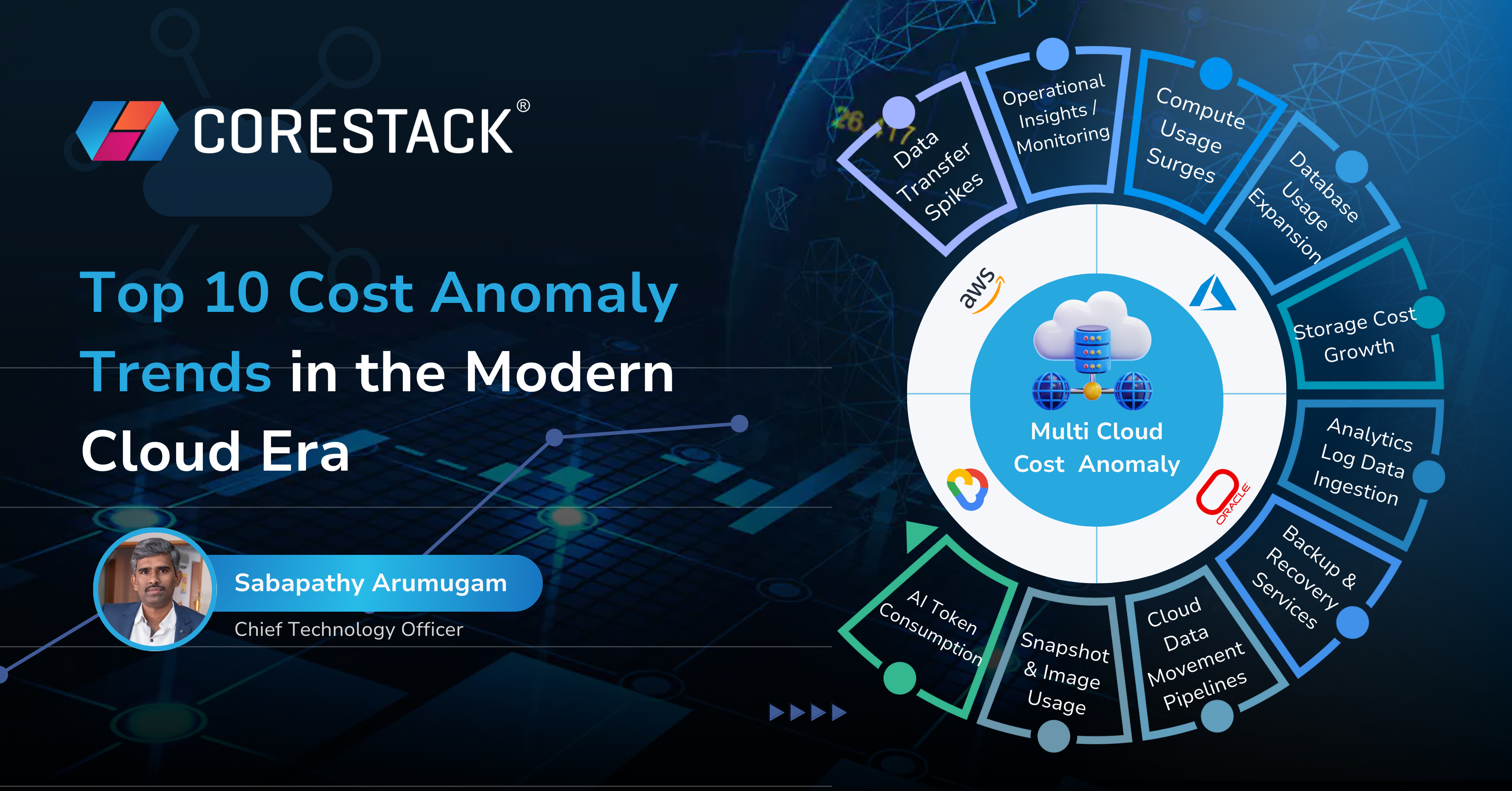
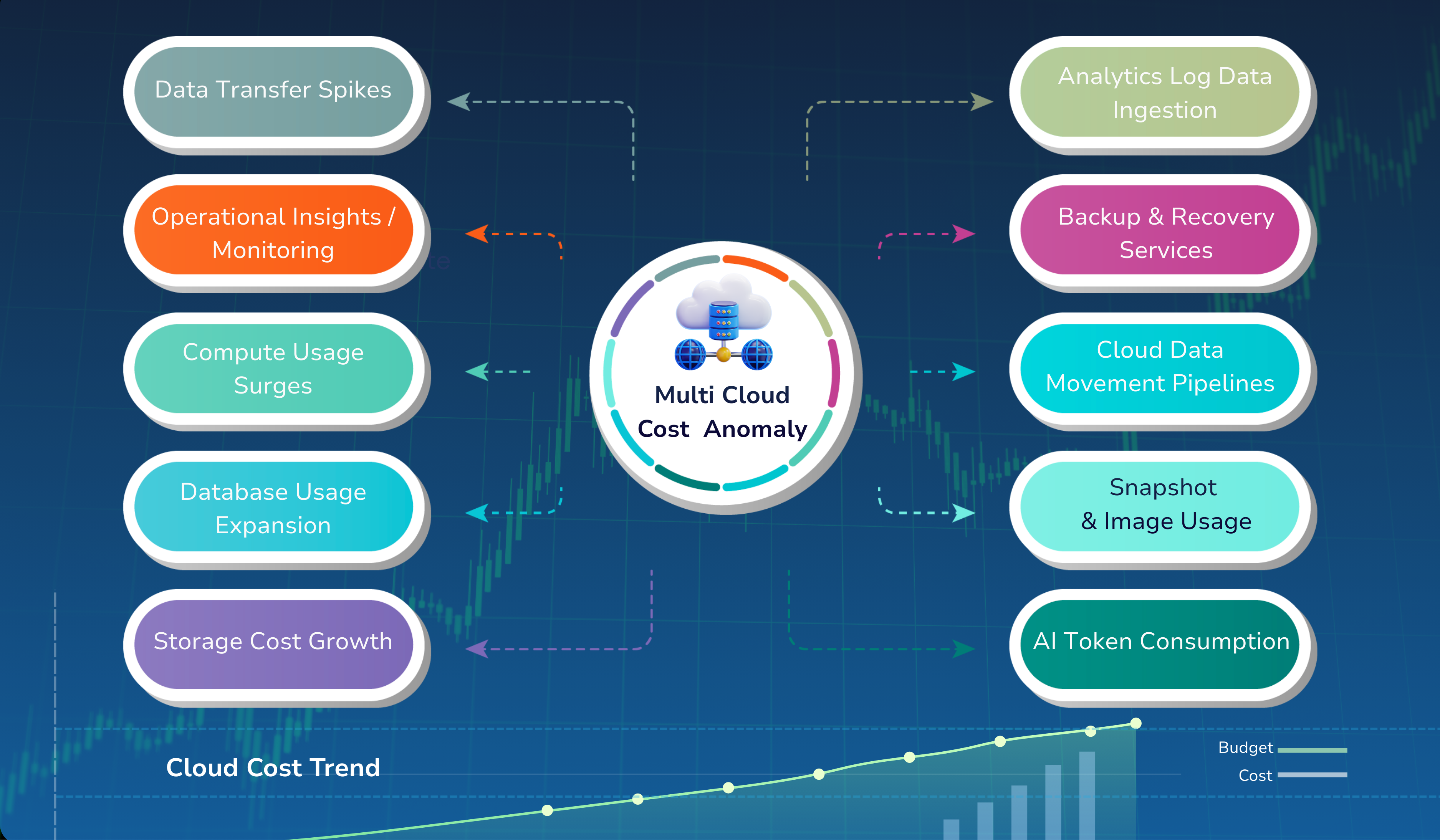
These are the top 10 categories driving the largest cost spikes:
- Data Transfer: Sudden cross region or cross cloud data movement can trigger unexpected egress charges.
- Operational Insights / Monitoring: Log and metrics ingestion can grow unpredictably due to high volume workloads or misconfigured alarms.
- Compute Usage Surges: Autoscaling bursts, newly deployed workloads, or runaway jobs can increase compute consumption.
- Database Usage Expansion: Query misconfigurations, scaling policies, or workload spikes often drive unexpected DB compute/IO utilization.
- Storage Cost Growth: Hot-tier storage expansion, rapid object creation, or long retained artifacts and logs.
- Analytics Log Data Ingestion: Overactive log ingestion jobs or pipelines generating excessive analytics ingestion costs.
- Backup & Recovery Services: Backup jobs increase in frequency or disaster recovery workflows expand beyond expected patterns.
- Cloud Data Movement Pipelines: Data transformation pipeline, retries, or misconfigured transfer jobs can result in unwanted data movement.
- Snapshot & Image Usage: Orphaned snapshots, oversized backups, or chained automated snapshots.
- AI Token Consumption: Rapid growth in LLM-driven workloads, inference, finetuning, or embedded AI use cases is the fastest growing anomaly category today.
How to Implement Effective Anomaly Detection in a Multi-Cloud Environment
- Build Cloud Specific Baselines
Each cloud service provider from AWS to Azure to GCP to OCI behaves differently as it provides different services, resources, metrics, and pricing. Use at least 4 months of historical data to model workload patterns and establish accurate, adaptive baselines for anomaly detection. - Combine Adaptive Thresholds, Trend Analysis & Noise Reduction
Static thresholds break in elastic environments. A more effective system should leverage rolling windows, dynamic confidence bands, seasonality aware trend prediction, and noise filtering for highly variable workloads to reduce false positives in anomaly detection. - Detect Anomalies Across Multiple Dimensions
Root cause clarity can enhance multilevel visibility. It requires detection at the Cloud account / Subscription / Project / Tenant, Service, Resource, Tag and Business unit level to ensure insights are clear and actionable. Multilevel visibility ensures anomalies are actionable rather than ambiguous. - Provide Real-Time Alerts with Deep Context
Every anomaly should include the impacted resource or service, magnitude and projected spend impact, probable root cause (configuration drift, pipeline retries, autoscaling activity), and associated project / team / environment to accelerate risk triage and eliminate uncertainty with back-and-forth investigation. - Integrate into FinOps Governance & ITSM Workflows
Detecting anomalies is only the first step. The real value comes from turning them into action by automatically notifying respective operations team, FinOps Practitioner, and application owners, generating ITSM incidents for high-impact anomalies, capturing resolution notes to build institutional knowledge, and routing accountability using tags and ownership metadata. This elevates anomaly detection into a continuous governance loop. - Continuously Validate & Improve Detection
Compare performance detection against benchmarks or alternate models, refine thresholds, and track false positives to validate performance. This helps create a strong feedback loop to ensure higher accuracy, trust, and long-term reliability.
Conclusion
Cost anomaly detection is foundational to financial governance in a multi-cloud environment. The trends show that ever-increasing AI spend is heightening cost anomalies as more teams turn to these powerful models to enhance productivity and drive deeper customer insights. By combining adaptive modeling, multidimensional insights, real-time observations, and strong governance integration, enterprise organizations can prevent waste, protect budgets, and operate with greater confidence as cloud complexity grows.
Discover how CoreStack helps enterprises detect and act on cost anomalies to optimize cloud consumption. Request a demo to get started.


